
Uneven Floors Often Signal a Deeper Condition
Floor movement and crawlspace concerns in Greater Birmingham for uneven surfaces, soft spots, and raised or separated flooring sections
Floors that feel uneven underfoot, show visible separation at seams, or develop soft spots in specific areas are telling you that something in the structure below has changed. Alabama Drainage Professionals works with Greater Birmingham homeowners to evaluate crawlspace conditions when floor movement or irregularity is observed, because moisture damage to floor joists, beam settlement, and wood deterioration are frequent contributors—and all of them originate beneath the surface rather than in the flooring material itself. Treating the flooring without evaluating the crawlspace produces a cosmetic fix over a structural condition that continues to develop.
What residents often describe as "raised floor joints" or displaced flooring can reflect several different conditions: floor joists that have absorbed moisture and twisted or bowed, subfloor sheathing that has swollen and pushed up against finished flooring, or beam and post connections that have shifted over time. In Avondale and other early-twentieth-century neighborhoods where bungalow construction relied on wood post-and-beam crawlspace framing, the supporting members were sized and spaced for dry conditions—prolonged moisture exposure accelerates movement in those systems in ways that show up as floor irregularity years before structural failure becomes visible from below.
Request a crawlspace evaluation to identify what conditions beneath your floor are contributing to the movement or unevenness you are noticing above..
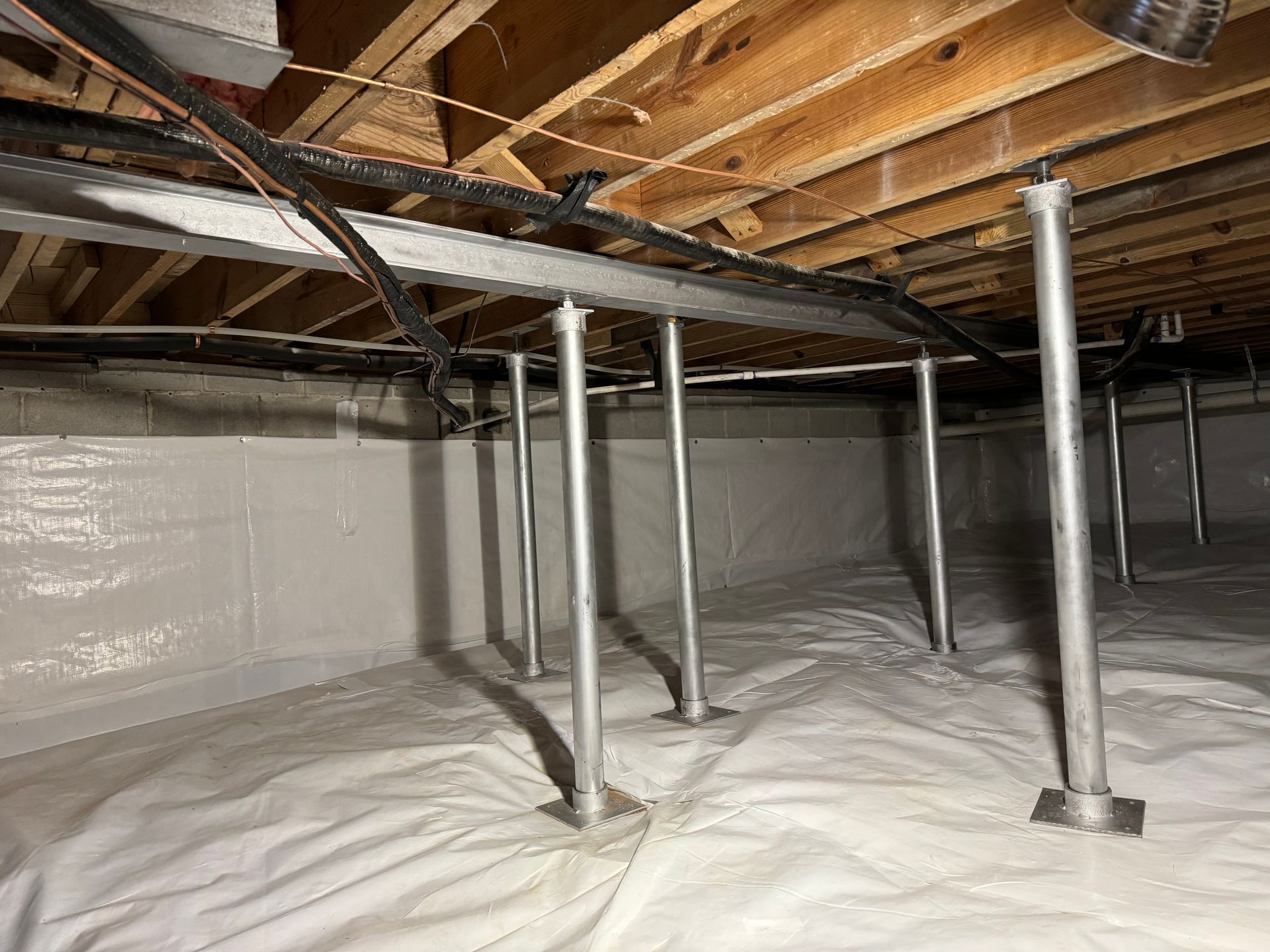
What Floor Movement Actually Reveals About the Crawlspace
Evaluating floor movement from the crawlspace involves checking the floor joists for signs of moisture damage—staining along the grain, soft areas that compress under pressure, and visible cupping or twisting. The evaluator also examines the vapor barrier, drainage condition of the crawlspace floor, and whether water has collected near any of the support posts. Each of these observations helps narrow whether the floor movement is primarily a moisture-wood interaction, a settling issue, or a combination of both, because that distinction drives which services are relevant.
After moisture control work is completed and the crawlspace environment stabilizes, wood framing that has been exposed to humidity without reaching structural failure will gradually approach equilibrium moisture content and stop moving. Floors above a dry crawlspace no longer experience the seasonal expansion and contraction driven by humidity cycling, which means seams that were opening and closing with conditions tend to stabilize. Whether existing damage to the floor framing requires additional structural repair is a separate evaluation, but stopping the moisture source is the prerequisite step regardless.
Depending on what the crawlspace inspection reveals, relevant services may include drainage system installation to redirect water away from the foundation, crawlspace encapsulation to eliminate ground vapor, foundation lifting where settlement has displaced support posts, or foundation wall repair where water pressure has affected the perimeter. Alabama Drainage Professionals identifies which of those apply to the specific conditions found beneath the home..
Answers About How the Crawlspace Investigation Works
Floor movement raises questions that span both the visible symptom and what is happening in the crawlspace below. The following addresses how the investigation is conducted and what findings typically mean for next steps.
How does a crawlspace inspection identify the cause of floor movement?
The evaluator probes floor joists with a moisture meter and a sharp tool to check for compression, documents the position and condition of support posts and beams, and maps any water entry points or drainage issues relative to where the floor movement is concentrated above.
What is the difference between a joist moisture problem and a settling problem, and why does it matter?
Moisture-damaged joists show wood degradation at the member itself and typically affect a localized area corresponding to a drainage or vapor issue; settlement affects post or beam positions and often shows as a gradual slope rather than a localized soft spot—the distinction determines whether drainage or structural lifting is the relevant intervention.
Why does addressing the crawlspace moisture matter before repairing the finished floor above?
Repairs to finished flooring over a crawlspace with active moisture continue to move and separate as the wood framing below responds to changing humidity, so the visible repair degrades on the same cycle as the original problem.
What does a floor joist in good condition feel like compared to one that has sustained moisture damage?
A structurally sound joist is firm and resistant when probed with a sharp instrument; a moisture-damaged joist compresses measurably or shows fiber separation at the surface, and in Greater Birmingham homes where crawlspace clearance is often limited, that assessment requires careful physical access to reach all sections of the framing.
How long after moisture control is established does floor movement typically stabilize?
Wood framing reaches equilibrium moisture content gradually; in most cases, movement associated with humidity cycling becomes noticeably less active within one to two seasons after active moisture sources are controlled, though the timeline varies with the severity of prior exposure.
Alabama Drainage Professionals can inspect the crawlspace beneath your home and provide a clear account of what conditions are driving the floor irregularities you are seeing. Also serves Hoover, Vestavia Hills, Trussville, and Bessemer. Set up an on-site crawlspace review to understand what is happening beneath your floor before pursuing surface repairs.