
Persistent Standing Water Disrupts Property Function
Commercial Drainage System Installation in Greater Birmingham for paved surfaces, building perimeters, and landscaped areas where runoff accumulates and does not resolve
Recurring pooling on a commercial property is not simply an aesthetic problem—it interrupts normal use of walkways, parking areas, loading zones, and landscaped spaces, and it concentrates water near building foundations where it creates long-term risk to the structure. Alabama Drainage Professionals installs commercial drainage systems across Greater Birmingham for property managers, business owners, and developers dealing with runoff patterns that standard grading has not resolved. The scope of commercial drainage differs from residential work primarily in scale and site complexity: larger impervious surfaces, multiple drainage zones, utility conflicts, and the need to route water to appropriate discharge points without creating new accumulation problems elsewhere on the property.
A properly planned commercial drainage system begins with identifying where water originates, how it moves across the site, and where it accumulates relative to the structures and paved areas it affects. Paved surfaces direct runoff toward low points that may not coincide with the site's intended drainage outlets. Landscaped areas between paved sections often collect water from multiple directions simultaneously. The system type—whether channel drains along paved edges, perimeter drainage around building foundations, catch basins at low points, or a combination of these—depends on where water collects and what path it needs to travel to exit the site.
Schedule a site visit to review the specific drainage patterns on your commercial property and identify which system components address the areas causing recurring problems.
What a Commercial Drainage System Actually Accomplishes
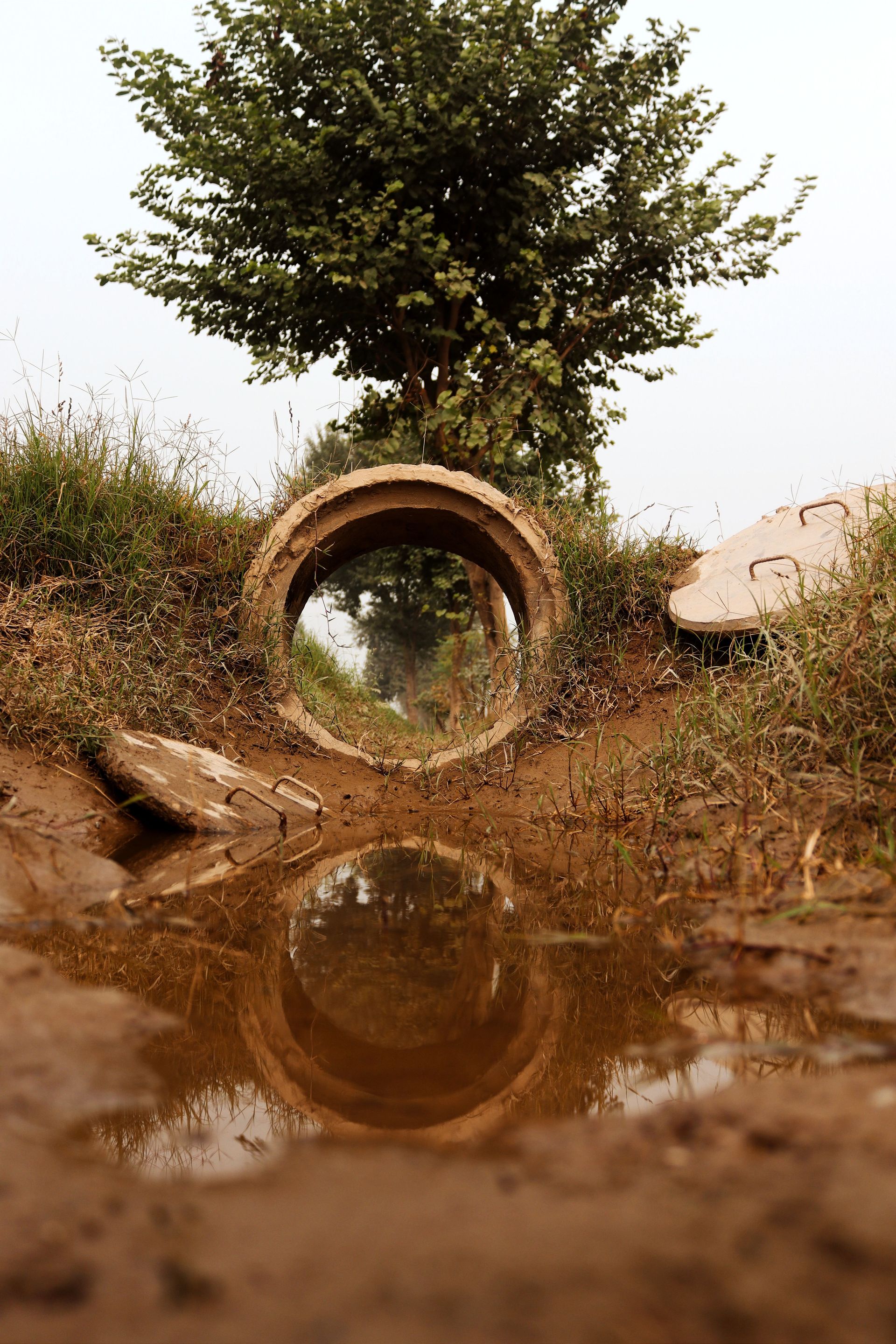
Commercial drainage installation involves coordinating multiple system components so water collected at one point is routed efficiently to a discharge outlet without surcharging other areas of the site. Catch basins are sized for the volume of water they are expected to receive based on the contributing drainage area and the surface runoff rate. Pipe sizing, slope, and connection sequencing are engineered to maintain flow without creating backpressure points that cause water to pool inside the system rather than drain through it. On sites with grade changes, this sequencing also determines where gravity drainage is sufficient and where the topography requires a different outlet approach.
Once a commercial drainage system is functioning, the most immediately observable change is that paved areas and building perimeters clear quickly after rain instead of holding standing water for hours or days. Walkways that were previously unusable after wet periods return to normal use, and water that was pooling against foundation walls no longer creates the visible staining and saturation patterns that indicate chronic accumulation. For properties where standing water was contributing to surface deterioration—soft spots in landscaping, erosion channels, or pavement undermining—those patterns also stop progressing once water is being actively directed away from the affected zones.
Commercial drainage systems often integrate with other site improvements. Where subsurface water—rather than surface runoff—is the primary issue, commercial French drain installation addresses the groundwater component that a surface channel system is not designed to collect. Commercial retaining walls on sloped properties affect how runoff moves across grade changes and may need to incorporate drainage provisions to avoid trapping water behind the wall face. Commercial erosion control addresses the ground surface conditions that runoff exposure creates over time. The appropriate combination of these services depends on the site's drainage geography rather than a single standard solution.
Questions Before Starting Your Project
Commercial property drainage questions often focus on how the system is designed and what distinguishes different component types. These answers address how the work is scoped and installed for commercial sites in Greater Birmingham.
How is the drainage system layout determined for a commercial property?
The layout follows the site's topography and the pattern of water accumulation. Low points, impervious surface edges, and areas adjacent to building foundations are the primary reference points, and the system is designed to intercept water at those locations before it pools rather than attempting to move it after it has already accumulated.
What determines whether catch basins or channel drains are the appropriate collection method for a given area?
Catch basins collect water from a defined low point or area and are most effective where runoff converges toward a single location. Channel drains collect water linearly along a paved edge or transition and are appropriate where runoff sheets across a wide surface rather than concentrating at one point. Many commercial installations require both, positioned according to how water actually moves across the specific site.
How do larger commercial properties in Greater Birmingham present different drainage challenges than residential sites?
Commercial properties typically combine large impervious areas—parking lots, loading docks, covered walkways—with landscaped sections and building perimeters, creating multiple drainage zones that interact with each other. Water from a paved section may direct toward a landscaped area that is already saturated, and a drainage system has to account for the combined load rather than treating each zone as independent.
What pipe sizing decisions are made during commercial drainage installation and why do they matter?
Pipe diameter and slope together determine how much volume the system can carry before it surcharges. Undersized pipe creates backpressure at the inlet, which prevents the catch basin or channel drain from accepting additional water during peak flow. Sizing is based on the contributing drainage area and the runoff rate for the surface types feeding that section of the system.
How do you confirm the system is functioning correctly after installation is complete?
A functioning system will visibly clear standing water from the target areas during and shortly after a significant rainfall event. Inlets should accept water freely without backing up, and the discharge point should show active outflow rather than a slow seep that indicates a blockage or slope problem within the pipe run.
Alabama Drainage Professionals also installs commercial drainage systems in Bessemer, Hoover, and surrounding communities. To review the drainage patterns on your commercial property and identify the system components that address your specific site conditions, connect with Alabama Drainage Professionals to arrange an on-site assessment.