
Settlement Beneath a Structure Needs Assessment
Foundation Lifting in Greater Birmingham for homes showing uneven floors, door frame separation, or visible signs of structural settlement
Sloping floors, doors that no longer close against their frames, or cracks that radiate from window corners are not cosmetic problems—they are the visible record of movement that happened beneath the structure. Alabama Drainage Professionals evaluates foundation settlement conditions and installs helical piers to provide supplemental support to portions of a structure that have displaced downward. The service is relevant to Greater Birmingham homeowners who have observed these changes over time and want to understand whether the underlying soil and structural conditions are appropriate candidates for foundation support work.
Helical piers are steel shafts with helical plates that are hydraulically advanced into the soil beneath the existing footing until they reach a bearing stratum capable of supporting the transferred load. The process does not require excavation of the full foundation perimeter and can often be completed with limited disruption to the surrounding grade. A bracket assembly connects the pier head to the existing footing, transferring the load from the foundation to the piers rather than to the soil that has already proven unable to support it. The number of piers, their spacing, and the required depth are determined during the evaluation based on the soil profile and the structural load.
Arrange a foundation evaluation to determine whether helical piers are appropriate for the settlement conditions present at your property.
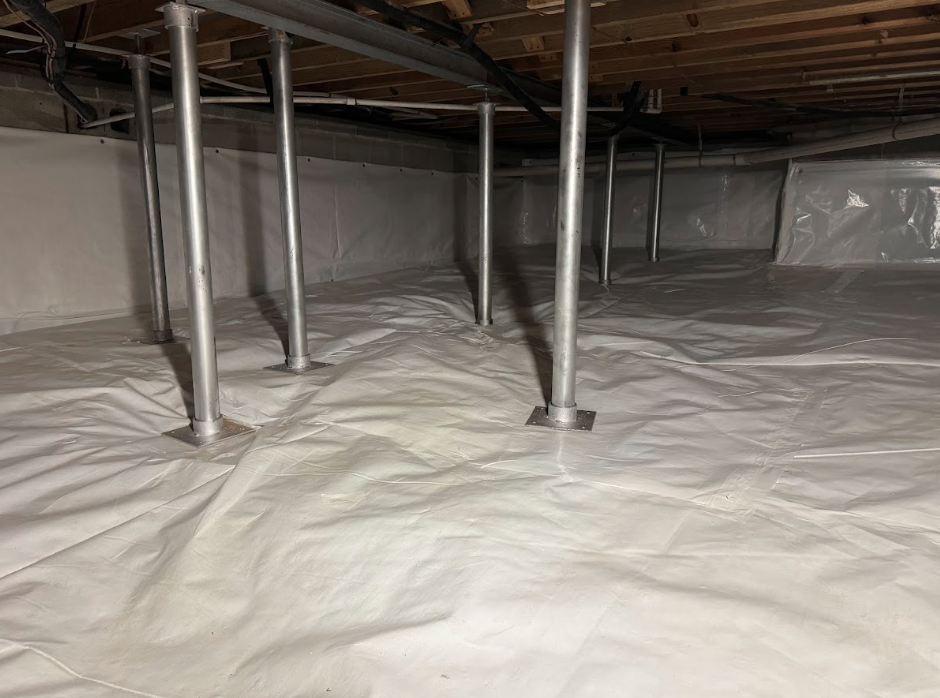
Why Settlement Happens and How Support Is Evaluated
Foundation settlement in residential construction most commonly follows one of two patterns: uniform settlement, where the entire structure descends gradually, and differential settlement, where one section drops more than another. Differential settlement produces the observable signs homeowners notice first—floors that slope toward one corner, gaps that open between the wall and the ceiling, and doors that begin binding at one corner of the frame while the gap on the opposite side grows. Helical pier installation targets the affected portion of the footing specifically, rather than treating the entire perimeter.
Once piers are installed and the bracket assembly is connected to the footing, the load transfer is complete. Homeowners often notice that the visible movement stops progressing—the gap at the door frame does not widen further, the floor slope does not increase, and cracks associated with the settlement event stabilize rather than continuing to open. Alabama Drainage Professionals documents the pre-installation condition so the structure's behavior after pier installation can be evaluated against a baseline rather than relying on memory of how severe the problem appeared before work began.
Foundation lifting addresses the structural support problem, but it does not resolve water management conditions that may have contributed to the soil instability beneath the footing. Drainage system installation and exterior waterproofing are separate services that manage water around and beneath the foundation. When both settlement and moisture are present, the structural evaluation and drainage planning are coordinated so that water is not allowed to continue affecting the soil conditions around newly installed piers. Foundation wall repair is also a distinct scope—bowing or cracking walls indicate lateral pressure, while settlement indicates vertical displacement, and both can be present on the same property without one causing the other.
Common Questions Before Starting Your Project
Homeowners considering foundation lifting often want to understand how the evaluation works and what the installation process actually involves at the footing level. These answers focus on the service and what takes place on site.
How does a foundation professional determine how many helical piers are needed?
The number of piers is based on calculating the load the foundation carries at the affected section and distributing that load across piers spaced to stay within the capacity of the bearing stratum reached during installation. This is a structural calculation, not an approximation, and it changes depending on the building's framing type, the footing dimensions, and the depth at which competent soil is encountered.
What happens at the footing during helical pier installation?
A bracket is attached to the existing footing—either underneath it or alongside it depending on the footing geometry—and the pier shaft is driven through that bracket hydraulically. Once the pier reaches the target bearing depth, the load is transferred from the footing to the pier shaft so the footing is no longer relying solely on the soil directly beneath it.
How does the construction era of a home in Greater Birmingham affect the foundation lifting evaluation?
Homes built in the region during the postwar construction period often have shallow continuous footings sized for the soil conditions assumed at the time of construction. When those soil conditions change over decades—through repeated loading, erosion, or subsurface shifts—footings that were originally adequate may no longer carry the structural load without additional support, making helical piers a relevant intervention for properties of that age.
Why do cracks associated with settlement look different from cracks caused by wall pressure?
Settlement cracks tend to follow a diagonal or stair-step pattern radiating from corners of openings, because the structure is rotating around a point as one section drops. Horizontal cracking, by contrast, is associated with lateral soil pressure on the wall itself. Distinguishing the crack pattern is one of the first steps in determining whether settlement, lateral movement, or both are present.
What should you monitor after helical pier installation to confirm the support system is functioning?
The most straightforward indicator is whether previously active cracks stop widening. Marking crack endpoints with a date at the time of installation and checking them periodically provides a simple, observable record. Doors that were binding due to frame distortion may also begin operating more normally once active settlement stops, though frame geometry does not always fully recover on its own.
Alabama Drainage Professionals also performs foundation lifting in Bessemer, Hoover, and surrounding communities. To review the settlement indicators at your property and discuss whether helical pier installation is a suitable approach, request a structural evaluation with Alabama Drainage Professionals.