
Saturated Ground Points to Subsurface Water Movement
Commercial French Drain Installation in Greater Birmingham for landscaped areas, building perimeters, and property sections where groundwater keeps ground persistently wet
Surface grading moves water that runs across the top of the ground. It does not address water that moves through the soil itself—groundwater that migrates laterally, rises from below, or drains slowly through soil that has a poor natural drainage rate. When a section of a commercial property stays wet long after surface water has cleared, or when landscaped areas remain saturated through periods without rain, the water source is subsurface rather than atmospheric. Alabama Drainage Professionals installs commercial French drains in Greater Birmingham to intercept and redirect that groundwater before it reaches foundations, retaining walls, landscaped plantings, or other site features where persistent saturation creates ongoing problems.
A French drain is a subsurface assembly that collects water through a perforated pipe embedded in a gravel-filled trench. The gravel provides a permeable pathway that groundwater preferentially enters rather than continuing to migrate through the surrounding soil. Once inside the pipe, the water flows by gravity to a discharge point—a daylight outlet, a catch basin connected to the site's drainage system, or another appropriate exit point. The trench depth, pipe diameter, and gravel specification depend on how much water the system needs to handle and at what depth the water is traveling through the soil profile.
Request a site evaluation to identify where subsurface water is entering your property and determine whether French drain installation is the appropriate collection method for those conditions.
How French Drain Installation Differs from Surface Drainage Methods
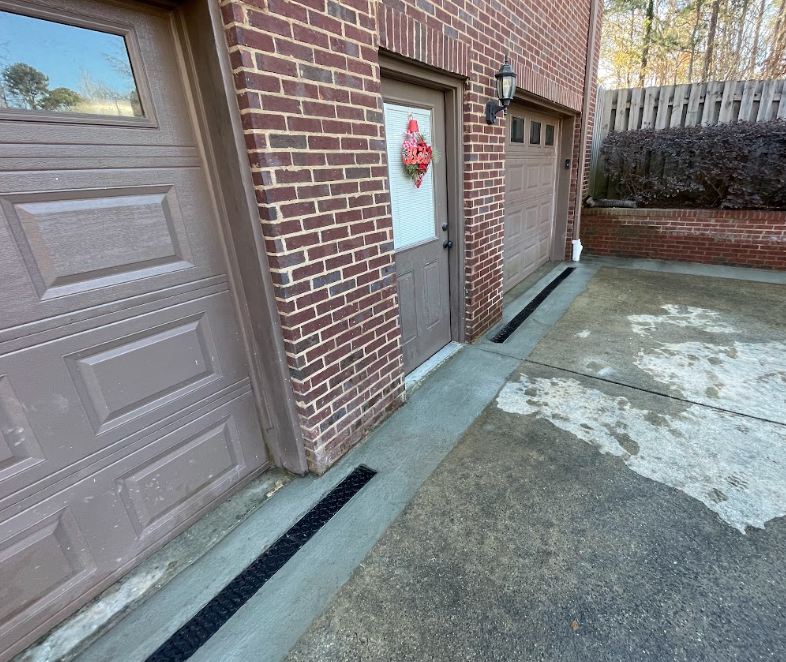
The functional distinction between a French drain and a channel drain or surface inlet is the source of water each is designed to collect. Channel drains intercept water that is running across an impervious surface during or after rainfall—water that is moving on top of the ground. French drains are positioned in the soil to intercept water that is moving through it. This difference in water source determines where each component is placed and how it connects to the broader drainage system. A commercial site dealing with both surface runoff and subsurface saturation typically requires both collection methods because neither alone addresses the full problem.
Once a commercial French drain is installed and functional, the ground in the treated area begins to drain rather than holding water between the soil particles. Landscaped sections that were previously too saturated for normal maintenance access become workable. Areas alongside retaining walls that were holding water against the wall face—creating hydrostatic pressure that accelerates wall movement—begin to drain the subsurface load the wall was resisting. Foundation perimeters that showed chronic moisture accumulation at the grade line dry out as the subsurface water that was migrating toward the foundation is intercepted before it reaches the building. Alabama Drainage Professionals assesses each installation location to confirm the pipe is positioned at the depth where the water is actually traveling, not simply at a convenient digging depth.
French drain installations on commercial properties are frequently incorporated into a broader drainage plan that also includes surface collection components. Commercial drainage system installation addresses runoff from impervious surfaces and routes it to appropriate outlets; a French drain handles the subsurface contribution. Where retaining walls are part of the site, commercial retaining wall drainage provisions work in parallel with the French drain to prevent water from building pressure behind the wall face. In areas where ground saturation has already produced erosion, commercial erosion control addresses the surface damage while the French drain resolves the underlying water condition that caused it. The sequencing and scope of these services depend on the site's specific drainage geography.
Common Questions About This Service
Commercial property owners often want to understand what distinguishes a French drain from other drainage components and how the installation is approached for different site conditions in Greater Birmingham.
How is the trench depth for a French drain determined on a commercial site?
The pipe is positioned at the depth where groundwater is actually moving through the soil profile, which requires understanding where the saturated zone sits relative to the surface. Installing the pipe too shallow means water below that depth continues to migrate uninterrupted; installing it unnecessarily deep increases cost without improving interception. Probe testing or site observation during wet conditions helps identify the correct depth for each installation segment.
What type of filter fabric is used around the gravel fill and why does it matter?
A geotextile fabric sleeve wraps the perforated pipe and sometimes lines the full trench to prevent fine soil particles from migrating into the gravel and eventually clogging the pipe perforations. On commercial sites with clay-heavy soils—common in many parts of the Greater Birmingham area—this filtration layer is critical because fine clay particles will fill a gravel void over time if the fabric is absent or improperly specified for the soil type present.
How do you distinguish a French drain problem from a surface drainage problem when diagnosing a wet area on a commercial property?
The timing of saturation is the clearest indicator. Surface drainage problems appear during or immediately after rainfall and clear as the water runs off or evaporates. Subsurface drainage problems persist well beyond the rainfall event because the water source is the soil itself rather than recent precipitation. An area that stays wet for days after the last rain, or that shows no clear surface water pathway leading into it, is typically a subsurface water condition.
What maintenance does a commercial French drain require after installation?
The primary maintenance consideration is keeping the inlet and outlet points clear of debris and confirming that the discharge outlet is not obstructed. The interior of the pipe and gravel fill require attention only if the system shows reduced performance over time, which is most often caused by fine material migration past a compromised filter fabric rather than routine accumulation.
Why does the placement of a French drain relative to a retaining wall matter?
Water trapped behind a retaining wall exerts hydrostatic pressure against the wall face, and that pressure is a direct contributor to wall movement and eventual failure. A French drain positioned upslope of the wall or directly behind it at the footing intercepts the subsurface water before it reaches the wall, reducing the pressure load the wall structure has to resist. The drain must be placed where it can intercept that water, not simply at the most convenient trench location.
Alabama Drainage Professionals also installs commercial French drains in Bessemer, Hoover, and surrounding communities. To review the subsurface drainage conditions on your commercial property and determine whether French drain installation addresses the water source causing recurring saturation, connect with Alabama Drainage Professionals to arrange an on-site assessment.