
Walls That Bow Require Specific Stabilization
Foundation Wall Repair in Greater Birmingham for horizontal cracking, inward wall movement, and visible deflection in basement walls
A foundation wall that has begun to bow, crack horizontally, or shift inward is responding to lateral pressure from the surrounding soil—a mechanical problem that does not correct itself and, without intervention, tends to progress. Alabama Drainage Professionals addresses structural deterioration in basement walls using two methods matched to the wall's condition: wall bracing systems and carbon fiber straps. The appropriate choice depends on the wall's material, the extent of movement already recorded, and whether active shifting is still occurring.
Wall bracing systems physically restrain the wall and, in some configurations, allow for gradual correction of the inward movement over time through periodic tightening. Carbon fiber straps are bonded directly to the wall surface to prevent further deflection where movement is in its earlier stages and the wall has not displaced significantly. Neither method is universally correct—a block wall with several inches of inward bow requires a different approach than a poured concrete wall with new horizontal cracking that has not yet moved. Evaluating the wall's material, the crack pattern, and the degree of displacement determines which system applies.
Request an evaluation of your basement walls to identify what type of movement is present and which stabilization method is appropriate for your property.
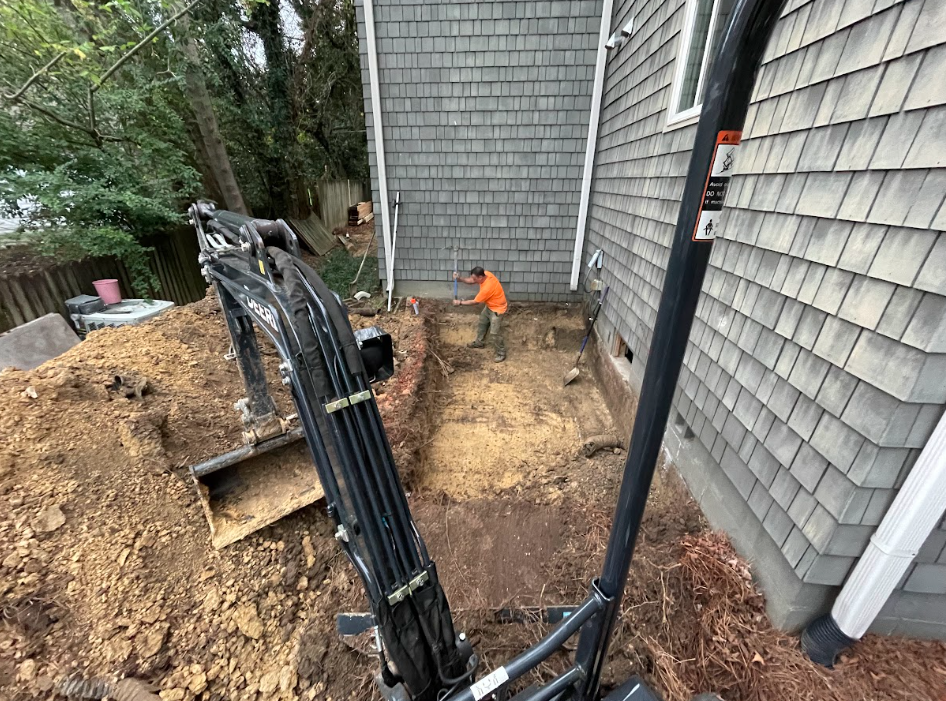
What Proper Foundation Wall Stabilization Requires
Before any stabilization system is installed, the wall condition must be documented accurately—not just the visible crack location, but the wall's angle of deflection and whether movement is still active. Carbon fiber strap installation involves grinding or preparing the block or concrete surface so the epoxy bonds to the wall structure rather than to a painted or deteriorated face. The straps are then anchored at the top plate and footing, running vertically at spaced intervals calibrated to the wall's span and load conditions.
Where wall bracing is used, the system anchors into the floor slab at the bottom and the floor system or rim joist above, creating a rigid assembly that distributes the soil load mechanically rather than relying on adhesive bonding. Once either system is in place, the wall no longer moves freely under soil pressure, and that stabilization is visible: cracks do not widen further, doors or windows near the wall stop showing new gaps at their frames, and the basement no longer exhibits the gradual changes in wall alignment that indicated active movement. Alabama Drainage Professionals documents the initial deflection so progress can be verified at follow-up.
When moisture is also present alongside structural wall problems, the two conditions are typically addressed in the correct sequence—wall stabilization before waterproofing treatment—because applying a membrane to a moving wall wastes the coating. When water pressure in the surrounding soil is contributing to the lateral load, drainage system installation or a French drain at the foundation perimeter can reduce that pressure and relieve the force the wall is resisting. Foundation lifting is a separate evaluation when floor-level settlement is also observed, as wall repair and settlement repair solve distinct structural problems.
What Property Owners Ask About the Work
Foundation wall questions often focus on what the visible signs mean and what the repair process actually involves. The following answers address the service itself based on how these conditions present in Greater Birmingham properties.
How do you determine whether carbon fiber straps or wall bracing is the right method?
The decision depends primarily on how much the wall has already moved. Carbon fiber straps are appropriate when deflection is limited—typically measured in fractions of an inch—and the wall material is sound enough to accept an epoxy bond. Wall bracing is the standard choice when movement is more advanced or when the wall needs the option to be gradually straightened over time.
What does a horizontal crack in a block foundation wall actually indicate?
Horizontal cracking in block walls typically marks the mortar joint where the highest bending stress concentrates due to lateral soil pressure. Unlike diagonal or stair-step cracks, which often follow differential settlement, horizontal cracks signal that the wall is flexing under an external load and should be evaluated promptly for active movement.
How does the age of construction in Greater Birmingham affect how foundation walls respond to soil pressure?
Many residential foundations in the area were built using concrete block through the mid-to-late twentieth century, and those hollow-core walls accumulate stress at the mortar joints differently than solid poured concrete. Block walls of that era are more susceptible to horizontal cracking at mid-span because the mortar joints represent the weakest link in the wall's resistance to lateral bending.
How do you know whether a crack you've been watching has actually stopped moving after repair?
The most reliable method is crack monitoring—marking the crack ends with pencil marks and dates at the time of repair. If the marks do not advance in the months following stabilization, the wall has stopped deflecting under the load. This is the same documentation approach used during the initial assessment to confirm whether movement was still active.
What preparation is required before carbon fiber straps are bonded to the wall surface?
The wall surface must be clean, dry, and free of paint, efflorescence, or spalling concrete that would interfere with the epoxy bond. In practice, this typically means grinding or abrading the surface at the strap locations before the adhesive is applied, because a strap bonded to a deteriorated surface provides no structural contribution.
Alabama Drainage Professionals also performs foundation wall repair in Bessemer, Hoover, and surrounding communities. To have your basement walls evaluated for movement, cracking pattern, and stabilization options, contact Alabama Drainage Professionals directly to schedule an on-site structural assessment.